

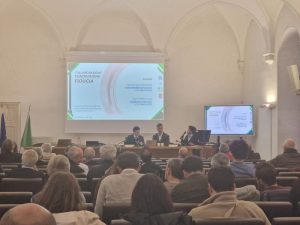
On February 26, 2026, at the conference “Research and Innovation for the Development of Underground Engineering Works” held at Sapienza University of Rome, AB Tunnelling presented a technical case study on the excavation of the Rocchetta tunnel, part of the Apice–Hirpinia railway lot.
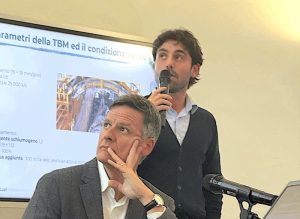
The presentation was delivered by Stefano Lupi (AB Tunnelling) in collaboration with Salvatore Barrasso (Consorzio Hirpinia AV) and focused on the challenges encountered during TBM excavation in abrasive sandstone formations and on the engineering strategies adopted to manage cutter wear and improve operational efficiency.
The study illustrates how geological analysis, equipment design and operational experience can work together to optimize tunnelling performance in complex ground conditions.
 Project overview and geological setting
 Project overview and geological setting
The Rocchetta tunnel is part of the Naples–Bari high-speed/high-capacity railway line (AV/AC Napoli–Bari), one of the major railway infrastructure projects currently under development in southern Italy. Within the Apice–Hirpinia railway section, the Rocchetta tunnel represents one of the main underground structures, together with the Grottaminarda and Melito tunnels.
It has a total length of 6,455 meters, an excavation diameter of 12.2 meters and an internal finished diameter of 10.8 meters. From a geological perspective, the tunnel alignment crosses the Baronia formation, which includes two main lithological units.
The first section intersects the Apollosa sandy member (BNA3), composed of poorly cemented sandstones and sandy deposits. The second section crosses the pelitic-arenaceous member of the Miscano Formation (BNA2), consisting mainly of marls and marly clays.
The most challenging conditions were encountered in the BNA3 sandstone, characterized by significant quartz content and abrasive behaviour.
Abrasivity analysis of the BNA3 formation
Laboratory investigations were performed to evaluate the abrasivity of the BNA3 lithotype and its potential impact on TBM tools. Mineralogical analyses showed that the material is mainly composed of quartz, calcite, plagioclase and K-feldspar, with smaller fractions of clay minerals and mica. Quartz plays a critical role because its hardness exceeds that of the steel microstructure used in cutting tools.
Several tests were performed to quantify abrasivity, including:
- Cerchar Abrasivity Index (CAI)
- LCPC abrasion test
- SAT test (soil abrasion test) for loose granular materials
The Cerchar tests indicated medium abrasivity, while granulometric analysis revealed deposits consisting of approximately 80% sand and 20% silt, conditions that still lead to continuous tool wear.
 Operational challenges during excavation
 Operational challenges during excavation
TBM excavation in the BNA3 sandstone generated several operational difficulties. The abrasive environment caused frequent maintenance operations, a high percentage of cutter replacements and irregular wear patterns affecting both cutting tools and structural components.
On average, the project required nine days of maintenance for every fifteen days of excavation, resulting in an average production rate of 7.8 meters per day. These conditions required continuous monitoring of TBM parameters and the adoption of corrective engineering strategies.
Cutter wear mechanisms
Detailed analysis of the disc cutters highlighted several wear mechanisms typical of abrasive rock environments. Quartz particles trapped between the cutter tip and the rock surface act as a grinding agent, generating tapering and grooving wear patterns, including the characteristic W-shaped wear observed during the Rocchetta excavation.
Another phenomenon identified was the formation of a white etching layer within the steel microstructure. This occurs when intense mechanical and thermal stresses create hardened but brittle zones that eventually detach from the cutter surface, accelerating wear. Understanding these mechanisms was essential for developing effective mitigation strategies.
Engineering solutions and results
Several corrective actions were implemented to reduce cutter wear and improve operational performance. One of the most effective measures involved modifying the cutter profile geometry, introducing a sharper angle that improves rock penetration and allows abrasive debris to evacuate more easily, reducing the grinding effect on the cutter surface.
Additional improvements were achieved through metallurgical optimization of the steel, including a finer grain structure and alloy compositions enriched with vanadium and chromium, which enhance abrasion resistance.
These solutions significantly improved cutter performance. Wear became more uniform and predictable, allowing better maintenance planning. In the peripheral positions of the cutting head where the optimized cutters were installed, replacement intervals increased to 350–400 meters of excavation. The average daily production has been increased from 7.8 meters per day to 13 meters per day thanks to the implemented improvements.
 Collaboration as a key factor
 Collaboration as a key factor
The Rocchetta tunnel experience demonstrates that successful TBM excavation in abrasive formations depends on the integration of geological knowledge, engineering design and field experience.
Equally important is the collaboration between contractor and equipment supplier, which allows technical challenges to be addressed through shared expertise and continuous optimization of excavation tools and operational strategies.
Planning a TBM project in abrasive ground conditions?
Contact our engineering team to discuss the most suitable cutting tools and technical solutions for your tunnelling project.
🌍 Join our professional network. Follow AB Tunnelling on LinkedIn for updates on our tunnelling technology.