In mechanized tunnelling, the quality of the precast segmental lining directly influences the service life of underground infrastructure; accordingly, every component of the lining is engineered to contribute to its overall performance.
At the core of every reliable precast tunnel lining system are three essential elements: tunnel segment gaskets, mechanical connectors and plastic accessories. These are not secondary details — they are critical to waterproofing, structural integrity, production efficiency and ring assembly accuracy. Their performance begins with design.
Mechanical connectors: precision, resistance and ring assembly
Tunnel segment mechanical connectors play a key role in segment assembly systems, ensuring correct alignment and load transfer at the circumferential joints of segment rings. Their effectiveness depends on the interaction between pin and socket design, geometry and materials.
A well-engineered connector must optimise pull-out and shear resistance, minimise play tolerances during assembly and deliver repeatable performance under real production and site conditions. Design and material selection are therefore essential not only for mechanical behaviour, but also for installation precision during ring erection.
Connector performance also directly affects the sealing system. Proper design helps maintain gasket compression, which is fundamental to the watertightness of the lining. For this reason, connectors should never be treated as isolated components, but as part of an integrated system engineered for both structural and sealing performance.
Tunnel segment gaskets: EPDM, geometry and long-term sealing
Tunnel segment gaskets are central to the performance of a waterproof tunnel lining. While the use of EPDM is well established, material choice alone is insufficient. Long-term performance depends on selecting the right compound, tailored to actual service conditions and durability requirements. At the same time, gasket design must balance multiple demands. The gasket must ensure high sealing performance under compression while correctly transferring stresses to the concrete, avoiding damage such as spalling, edge chipping or cracking. Geometry, anchoring design and positioning relative to the extrados are therefore critical considerations.
Gasket systems must also be engineered to facilitate application during casting in the precast plant, improving efficiency and reducing manual operations. In this sense, a high-performance gasket is not merely a sealing profile — it is the result of material science, structural engineering and design for industrial production.
Plastic accessories: small components, major impact
Plastic accessories play a vital role both in facilitating the alignment of segments within the same ring (guiding rods) and as inserts for lifting (lifting sockets), secondary grouting (grout sockets) and the installation of tunnel services (e.g. rail service sockets and ferrules).
Properly designed socket holders ensure quick and reliable fixing to segment moulds prior to
the concrete casting phase. Their design must guarantee durability, ease of use and dimensional precision. Even minor inefficiencies at this stage can lead to tolerances, assembly difficulties or quality issues that affect the overall performance of the lining system. In precast production, small components often make a significant difference.
Integration with moulds: design for production efficiency
Performance must also translate into efficient production. For this reason, the interaction between accessories, gaskets, connectors and segment moulds is a key part of the engineering process.
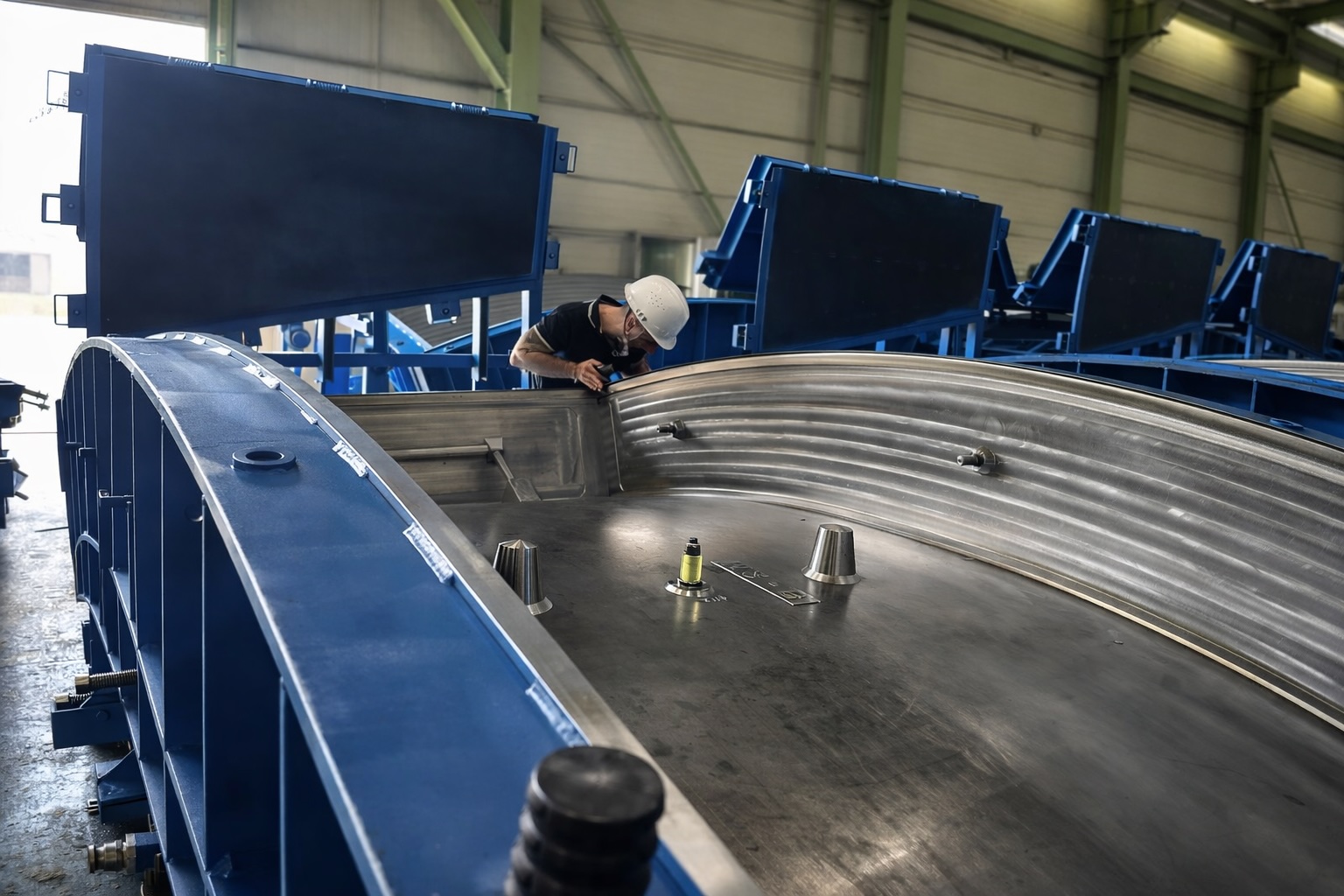
In collaboration with Korea Mould, functional solutions have been developed for secure socket fixing to moulds with dedicated socket holders, reliable gasket clipping and full compatibility with the opening kinematics of side shutters, including translational movements. Connector socket holders are engineered for fast, safe and durable fixing, ensuring ease of use and reliability across repeated production cycles.
This production-oriented approach improves installation speed, simplifies operations in the mould and enhances repeatability and quality control in the precast plant.
From today’s efficiency to tomorrow’s automation
The next step is automation. Ongoing developments are exploring semi-automatic and robotic systems for installing sockets and gaskets into moulds. The goal is to reduce manual operations, improve consistency and lay the groundwork for more advanced production processes, including cobot-assisted solutions. This is an evolving field, but the direction is clear: deeper integration between component design and industrial automation.
Testing, standards and integrated service
Reliability also depends on rigorous testing and shared standards. AB Tunnelling is currently the only Italian company participating in a STUVA international working group focused on developing guidelines for the testing of tunnel segment accessories. This involvement reflects a strong commitment to performance validation and continuous technical improvement.
At the same time, the collaboration between AB Tunnelling, FIP MEC and Korea Mould enables a turnkey approach, in which design, accessories, mould integration and service are developed as a single, coordinated solution.
Conclusion
In tunnelling, what appears secondary is often decisive. Tunnel segment gaskets, mechanical connectors and plastic accessories are not merely components — they are part of a coordinated system engineered to ensure waterproofing, durability, structural reliability and production efficiency in modern precast tunnel lining applications.
Discover more
Explore how integrated design enhances performance in precast tunnel lining systems.