In tunnelling, no one builds alone
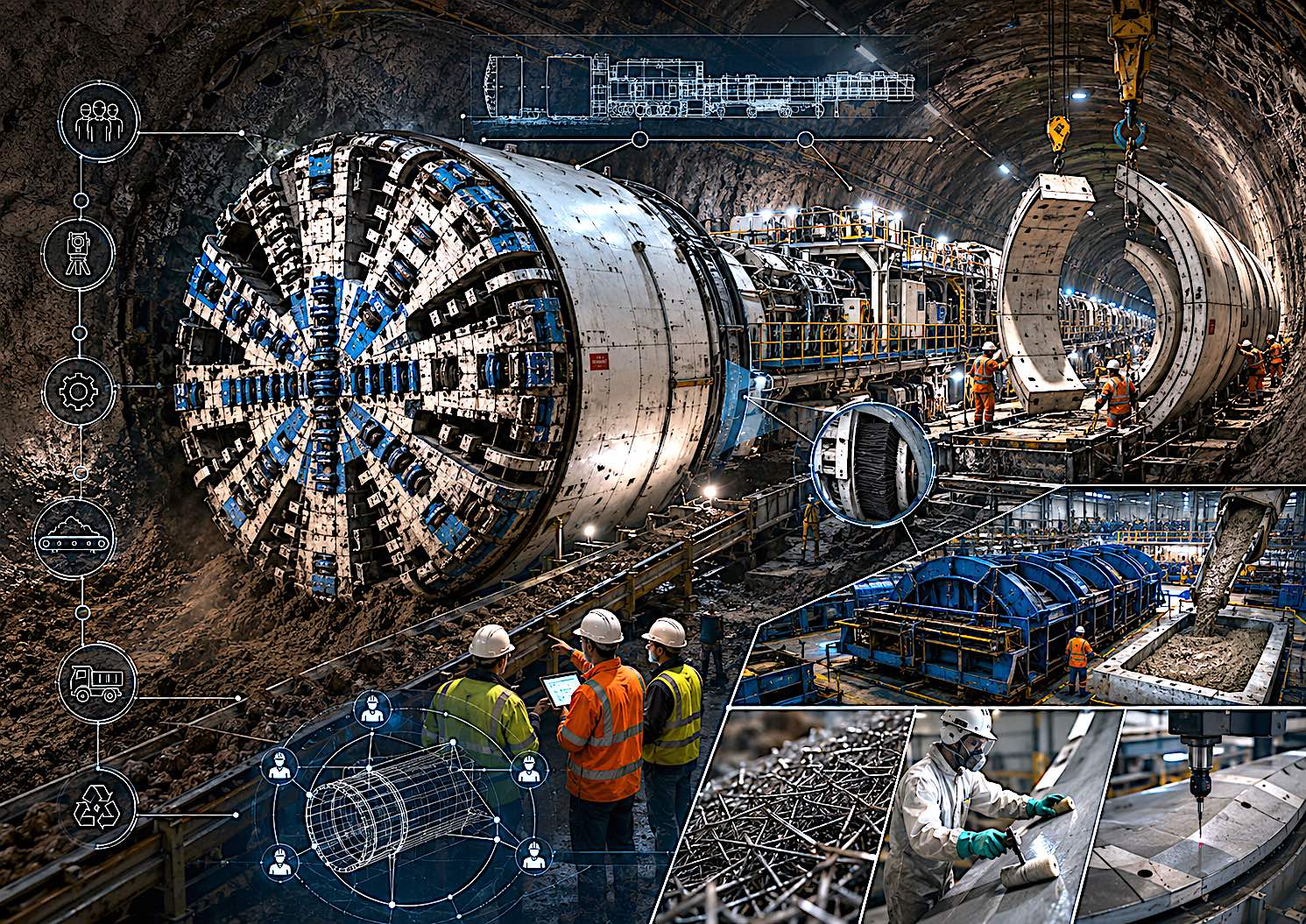
Excavating a tunnel with a TBM means orchestrating a chain of technical processes that span several engineering disciplines. The cutterhead advances, the spoil is managed, the precast lining takes shape segment by segment, the ring closes — each stage depends on the one before it and conditions the one that follows.
A tolerance error in the steel tunnel segment moulds translates into ring-assembly problems under the thrust of the TBM. A fibre chosen without accounting for excavation thrust weakens the segment exactly where stress concentrations are highest. An inadequate release agent damages the mould surface over thousands of casting cycles, compromising dimensional accuracy and slowing production. A TBM tail-seal system that cannot hold pressure in difficult ground turns backfilling into a costly, unpredictable operation.
AB Tunnelling’s own product lines sit at the centre of this TBM tunnelling supply chain: RingX cutting rings, engineered for performance and durability in the most demanding rock conditions, and BrushX tail brushes, designed to maintain the pressurised chamber that makes effective backfilling possible. Around them, a network of specialised partners covers the remaining critical layers — from precast tunnel segment production to TBM chemical consumables. Each partner brings deep, specific expertise that integrates with the others. Here is who they are, what they actually do, and why they make the difference.
Globalchimica — TBM chemical consumables: protecting the machine from the excavation face to the tail
Founded in 1949 and based in Lombardore (Turin,Italy), Globalchimica Srl brings over 70 years of experience in developing and manufacturing specialised chemical formulations for civil engineering. In TBM tunnelling, it works with AB Tunnelling on the development, promotion and after-sales service of a product range that covers three critical functions within the excavation process.
Tail-seal system. As the TBM advances, the annular void between the segments and the excavated ground must be filled with backfilling grout under controlled pressure. Maintaining that pressure depends entirely on the quality of the tail-seal chamber. Globalchimica’s GLOBALSEAL TBM/C line is pumped continuously during excavation to fill the inter-brush chambers, preventing grout, water and soil from entering the shield. For high-pressure conditions or brush deformation, GLOBALSEAL TBM/C Emergency provides an immediate watertight barrier — a formulation designed for the moments when stopping the machine is not an option.
Main-bearing protection. The main bearing is the most critical and expensive component of the entire TBM. GLOBALSEAL TBM/T seals it against the ingress of water, mud and abrasive particles, while GLOBALSEAL EP2 ensures continuous lubrication under the most severe operating conditions, extending service life and reducing the risk of unplanned downtime.
Ground conditioning. In EPB machines, managing the excavated material at the face is a primary technical variable. Globalchimica’s ground-conditioning solutions help control earth pressure, reduce cutting-tool wear and maintain muck workability across variable geological conditions.
- Complete tail-seal range: formulations for start-up (TBM/C 1P), continuous operation (TBM/C) and emergency
- Main-bearing sealing and lubrication systems (TBM/T + EP2)
- Ground-conditioning solutions for EPB tunnelling
- Over 70 years of chemical-formulation expertise for underground construction
🌐 Globalchimica: globalchimica.com
Korea Mould — steel tunnel segment moulds: South Korean precision for European projects
Korea Mould embodies a manufacturing culture rooted in the South Korean heavy-industry tradition, where dimensional precision is the starting point, not a target to chase. Its tunnel segment moulds are engineered with full parametric 3D models, cut with laser and plasma technologies, and built in certified high-strength steel. Tolerances in line with the restrictive recommendations issued by bodies such as the BTS are not a cosmetic detail: they are the precondition for the resulting segments to assemble correctly under TBM thrust and along the tunnel alignment.
The product portfolio comprises stationary and carousel mould systems suited to any production volume, mechanical and vacuum clamps, tilters for demoulding and the safe handling of segments, complete design of precast plants and layouts, and survey and refurbishment services for existing moulds. Projects delivered in South Korea, Japan, Singapore, Turkey, the Middle East, Australia and South-East Asia — but also in Italy, Algeria and Romania — place Korea Mould among the very few manufacturers with a truly global track record in this specialised field.
- Laser and plasma cutting with very tight tolerances
- Stationary and carousel mould systems for any production volume
- Complete precast-plant design, handling equipment and layout
- Refurbishment and dimensional-survey services for existing moulds
🌐 Korea Mould: kmceng.en.ec21.com
Ecoratio — concrete release agent: a quality factor in the production cycle
In the precast production cycle, there is one step that rarely gets the attention it deserves: releasing the segment from the mould. Yet it is a critical moment. A release agent that is inadequate or poorly applied can damage the segment surface, require costly rework and slow down the entire production line. Across runs of thousands of segments, the cumulative effect is anything but negligible.
Founded in 1998 and based in Werkendam (Noord-Brabant), the Netherlands, Ecoratio is a specialised developer and manufacturer of eco-friendly, plant-based release agents and waxes for the concrete, precast and asphalt industries, serving clients across Europe and worldwide through a network of regional offices. As AB Tunnelling’s partner for concrete release agents, Ecoratio supplies a formulation engineered specifically for the demands of professional precast tunnel segment production.
Applied to the mould before each casting cycle, the agent enables clean release of the segment without damaging the surface, ensuring uniform finishes that reduce or eliminate the need for rework. The product is a plant-based, ready-to-use emulsion, solvent-free and non-toxic, biodegradable to the OECD-301-B standard and non-flammable — characteristics that meet the growing regulatory requirements on chemical management in modern precast plants.
- Ready-to-use plant-based emulsion: solvent-free, non-toxic, non-flammable, easy to apply
- Biodegradable to OECD-301-B: compliant with the environmental regulations of modern plants
- Uniform surface finish — reduces or eliminates the need for rework
- Directly integrated with the Korea Mould system for whole-life-cycle mould protection
🌐 Ecoratio: ecoratio.com
FIP MEC — segment accessories and gaskets: civil-engineering expertise since 1945
Based in Selvazzano Dentro (Padua, Italy), and active since 1945, FIP MEC S.r.l. is an international reference for accessories and gaskets for precast tunnel segments, with over 130 major references worldwide and more than 6 million Biblock mechanical connectors installed.
In a precast segmental lining, accessories and gaskets perform fundamental structural and watertightness functions that concrete alone cannot fulfil. The sealing gasket waterproofs the joint between adjacent segments — the most critical interface for the long-term integrity of the tunnel. The Biblock connector centres and joins the rings, allowing rapid installation without traditional bolting. Longitudinal guide rods aid the centring of the segments that make up the lining ring. The packers (load-distribution pads) spread the loads of the TBM rams across the thickness of the segment, avoiding the stress concentrations that would cause cracking under the highest loads.
FIP MEC carefully develops and designs every single accessory, mechanical connector and gasket profile, operates an in-house certified laboratory for the characterisation testing of all accessories, for mechanical tests and for watertightness tests, and works to the most stringent international standards. FIP MEC’s anchored gaskets, in particular, eliminate the gluing stage during precasting — with direct benefits in cycle times, process cleanliness and reduced environmental risk associated with adhesive management.
Integration with the steel moulds for precast tunnel segments is studied and developed right from the design phase: the gasket seats (the clipping) and the engagement systems for the connector sockets and FIP MEC service sockets are shared with the mould manufacturer, eliminating the risk of incompatibility — a scenario that, on site, carries far from negligible costs and schedule impacts.
- In-house design, prototyping and testing with a qualified and certified laboratory
- Anchored gaskets: no gluing required, with direct benefits for quality, hydraulic performance and cycle times
- Biblock connectors: fast, precise ring assembly without traditional bolting
- Smart design of gasket clipping and of the accessory-engagement systems within the mould
🌐 FIP MEC: fipmec.it
La Matassina — fibres for fibre-reinforced concrete tunnel segments
Active since 1980 and based in Isola Vicentina (Vicenza), Italy, La Matassina Srl is among the leading Italian manufacturers of concrete fibres, with a catalogue that responds directly to the structural requirements of precast tunnel segments.
In TBM tunnelling, fibre-reinforced concrete (FRC) tunnel segments replace or complement traditional bar reinforcement — with tangible advantages: elimination of reinforcement cages where design conditions allow, improved impact resistance during demoulding and handling operations, and ductile redistribution of stresses under the non-uniform thrust of the TBM rams. The structural contribution of fibre reinforcement is not uniform across projects: soil type, earth pressure, segment geometry, environmental exposure class and fire-resistance requirements all influence the optimal mix.
La Matassina’s product range for tunnel segments includes cold-drawn steel fibres with tensile strengths up to 2,500–3,000 MPa, macro-polymer fibres with a double omega hook, and polypropylene microfibres.
La Matassina was the first company in Italy to obtain the FDES (Fiche de Déclaration Environnementale et Sanitaire) for both steel and polymer fibres — an environmental product declaration increasingly required in international tenders subject to ESG criteria, and a tool that allows designers to assess the whole-life-cycle impact of reinforcement materials.
- High-strength cold-drawn steel fibres (up to 3,000 MPa) for structural FRC segments
- Macro-polymer and polypropylene solutions for specialised applications
- First Italian company with FDES certification for steel and polymer fibres
- Technical consultancy on the fibre-reinforced mix, integrated into the AB Tunnelling workflow
🌐 La Matassina: lamatassina.it
Sales network: Massimo Ciarla (USA)
AB Tunnelling’s internationalisation is not only a matter of technical partnerships: it is also a network of sales agents rooted in their own markets, who bring specialised expertise and established industry relationships directly to the clients who require a continuous local presence.
Massimo Ciarla is AB Tunnelling’s Sales Advisor for the United States market, providing direct, qualified coverage of North America — bridging the company’s technical offering and the contractors, engineers and clients who require a competent, ongoing local point of reference.
✉️ Direct contact: massimociarla5@gmail.com
LinkedIn | Massimo Ciarla
The network is the product: a complete TBM tunnelling supply chain
Tunnelling rewards specialisation but penalises fragmentation. Having the best mould without a compatible gasket system and without the right release agent or wax, or the most advanced TBM tail-seal chemistry without a technically well-designed and well-manufactured brush, generates inefficiencies that are paid for on site — not in the office.
The AB Tunnelling partner network is built around this awareness. Each partner covers a specific technical layer; each layer is designed to work with the others. The result is the difference between a supplier that lists components and a partner that supports precast tunnel segment production from the plant floor to TBM advance — with a single point of responsibility and an integrated technical response at every stage of the TBM tunnelling supply chain.
👉 Read the full article and explore our partner network: www.abtunnelling.com
👉 Contact our team for technical consultancy and collaboration opportunities: sales@abtunnelling.it
👉 Subscribe to the AB Tunnelling Newsletter to receive upcoming issues directly
👉 Follow AB Tunnelling on LinkedIn for updates on tunnelling and precast innovation
#TBMTunnelling #PrecastTunnelSegments #MechanizedExcavation #TunnelEngineering #UndergroundConstruction #Globalchimica #KoreaMould #Ecoratio #FIPMEC #LaMatassina #TunnellingPartners #FibreReinforcedConcrete #TBMConsumables #Precast #Sustainability #Infrastructure