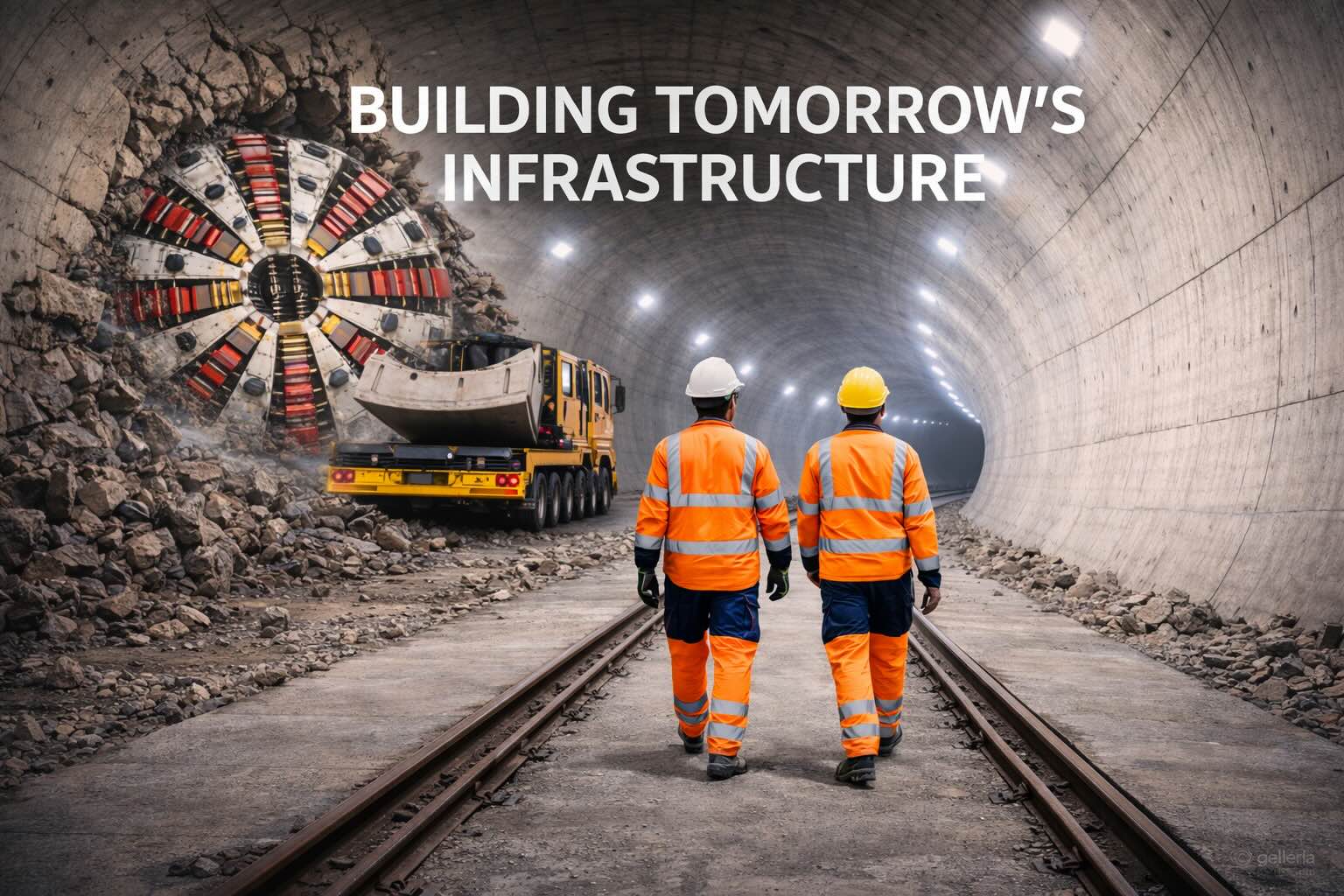
Mechanized excavation with TBMs has become the benchmark for modern tunnel construction, especially in complex infrastructure projects where time, safety, and cost control are critical. Compared to traditional excavation methods—such as drill & blast or partial-face machines—TBMs allow a fully industrialized process that combines continuous excavation with immediate ground support.
According to the International Tunnelling Association (ITA-AITES), mechanized excavation with TBMs improves worker safety, enhances lining quality, and enables excavation in challenging geological conditions, while significantly reducing environmental impact. These characteristics make TBMs not only a technical solution, but a strategic choice for large-scale projects.
Operational benefits of TBMs in tunnel construction
One of the key operational benefits of TBMs is continuous advancement. A tunnel boring machine excavates the full face while simultaneously installing the precast lining, ensuring immediate stabilization of the tunnel. This reduces downtime associated with temporary supports or manual lining operations and results in faster overall project completion, especially for long tunnels.
From an environmental perspective, mechanized excavation generates fewer vibrations and less noise than conventional methods. Dust and debris are better controlled, making TBMs particularly suitable for urban areas or environmentally sensitive zones.
Safety is another major advantage. TBMs operate within a protected shield, significantly reducing worker exposure to unstable ground conditions. Modern machines are designed to manage water pressure, gas presence, and variable geology, lowering the risk of sudden inflows or collapses. As a result, TBMs provide a safer, more predictable excavation process.
Management and economic benefits for infrastructure projects
For clients, CEOs, and project managers, the operational advantages of TBMs translate directly into measurable business value. Faster excavation means shorter project timelines, allowing strategic infrastructure—such as metro lines, railway tunnels, or road connections—to enter service earlier and generate returns sooner.
Process continuity reduces delays and contractual disputes. With fewer interruptions, project schedules become more reliable, and resource planning is more efficient. While the initial investment in a TBM is significant, the cost per kilometer becomes competitive on medium and long alignments due to higher productivity and reduced labor exposure.
Another key advantage is data-driven project management. Modern TBMs provide real-time monitoring of excavation parameters such as torque, thrust, pressure, and tool wear. This allows predictive maintenance planning, optimized consumable usage, and reduced risk of unplanned downtime—an increasingly important factor in complex tunnelling projects.
High-quality equipment: a key factor in TBM excavation
While the TBM itself defines the excavation method, the performance and reliability of mechanized excavation depend heavily on the quality of the equipment and consumables supporting the machine. Tools, sealing systems, chemicals and precasting components all play a decisive role in productivity, safety and overall project costs.
Disc cutters
Disc cutters are at the core of full-face excavation. Their design and material quality directly affect penetration rate, wear resistance and machine efficiency. Cutting rings manufactured from advanced steels and treated with specialized processes ensure longer service life and reduced replacement frequency.
The use of high-performance disc cutters allows smoother advancement, limits mechanical stress on the TBM and reduces the need for cutter changes, improving both productivity and safety during excavation.
Tail brushes and sealing systems
Effective sealing between the TBM shield and the tunnel lining is essential for stable and continuous advancement. Reliable TBM tail sealing systems retain backfilling grout and prevent water or soil infiltration, protecting both the machine and the tunnel structure.
High-quality tail brushes and sealing greases ensure consistent performance over long distances, minimizing the risk of leaks, flooding or unplanned stoppages that could compromise excavation progress.
Chemicals and special consumables
Foams, polymers, additives and lubricating greases play a crucial role in adapting TBM operation to variable geological conditions. These materials—commonly referred to as TBM conditioning chemicals—improve soil behavior at the face, reduce friction and mechanical stress on cutting tools, and protect critical machine components.
By optimizing ground conditioning, quality consumables contribute to smoother excavation, increased safety and more sustainable tunnelling operations.
Formwork and components for precast segments
The quality of the tunnel lining depends largely on the precision of the formwork used to produce precast segments. Accurate geometry, tight tolerances and reliable joint sealing are essential to ensure fast installation and long-term structural performance.
Well-designed precast segment production systems support continuous segment manufacturing, reduce the risk of defects and facilitate efficient assembly inside the tunnel, preventing delays that could negatively impact TBM advance rates.
Conclusions: maximizing the value of mechanized excavation with TBMs
In today’s infrastructure landscape, mechanized excavation with TBMs represents a proven and strategically advantageous solution—provided it is supported by reliable, high-quality equipment. Every component, from cutting tools to sealing systems, plays a decisive role in excavation performance, safety, and long-term tunnel durability.
Investing in quality means achieving higher daily advance rates, fewer interruptions, and reduced operational risks. Certified materials and systems compliant with international standards help ensure predictable outcomes and compliance with project specifications.
To fully leverage the operational benefits of TBMs, clients, contractors, and decision makers must rely on experienced and specialized partners. Companies such as AB Tunnelling, with expertise in cutters, sealing systems, consumables, and precast solutions, provide the technical support and customized approach required for complex mechanized tunnelling projects.
Ultimately, the success of a tunnel depends not only on the power of the TBM, but on the synergy between technology, materials, and expertise—working together to deliver safe, efficient, and sustainable underground infrastructure.
👉 Discover the expertise behind advanced mechanized tunnelling solutions by AB Tunnelling
🧩 Need a custom backfilling solution? Contact our engineering team for your tunnelling project. 📩 Contact us
🌍 Join our professional network. Follow AB Tunnelling on LinkedIn for updates on our tunnelling technology.